Where Should the Comma Go in the Following Sentence? Play It Again Sam.
Lesson xiii: Commas
/en/grammar/abbreviations-and-acronyms/content/
What is a comma?
A comma is a punctuation marking that can be used in many dissimilar ways. Mainly, it's used to split things—for case, 2 thoughts in a sentence, multiple adjectives, or items in a list.

There are many rules that tell the states how commas should exist used, only don't let information technology scare you. With a little practice, it'll get-go to experience like 2nd nature. Some rules are ready in rock. They work the same manner every time, so you lot don't accept to think about them too much. Other rules are more complicated. In these cases, you take to understand the significant of the sentence to know when and where to utilise the comma.
Using commas
The basic rules for using commas are pretty foolproof. In other words, they're piece of cake to apply to your writing because they always work the same way. Yous don't accept to worry near any special exceptions or wonder where the comma is supposed to become. Each rule tells you exactly what to do.
Joining ii sentences
You already know how to bring together ii sentences using conjunctions like and, or, merely, and so. We do information technology all the fourth dimension in regular chat, if not in writing.
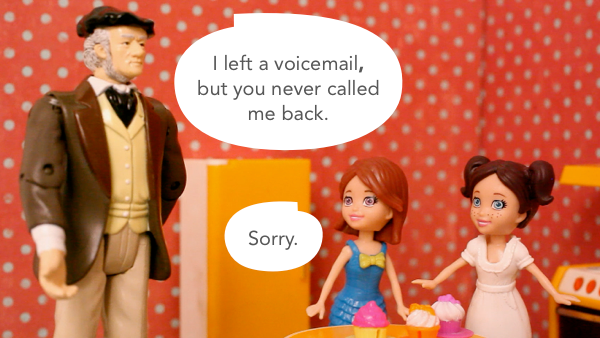
Equally you tin see, the comma goes between the two sentences, right earlier the conjunction. It tells y'all where i thought ends and another begins. Placing the comma later on the conjunction would be incorrect because the conjunction is office of the second thought.

Listing items in a judgement
Commas can also be used to split up three or more items in a list. But identify a comma between each item (and an appropriate punctuation marking at the cease). The last particular is ordinarily joined by a conjunction like and, or, or nor. Like the rule for joining sentences, the comma goes right earlier the conjunction.

Identify names and dates
There are certain types of place names (for example, city/land and state/state) that are always separated by a comma when you write them out. Y'all can see this rule in action on whatsoever mailing envelope.

Phoenix is a place inside Arizona—that'southward why there'south a comma between the metropolis and state. This rule applies whenever y'all refer to a place in a similar fashion, whether information technology'due south MTV Studios , Times Square (which isn't fifty-fifty a city, land, or country) or England , United kingdom of great britain and northern ireland.
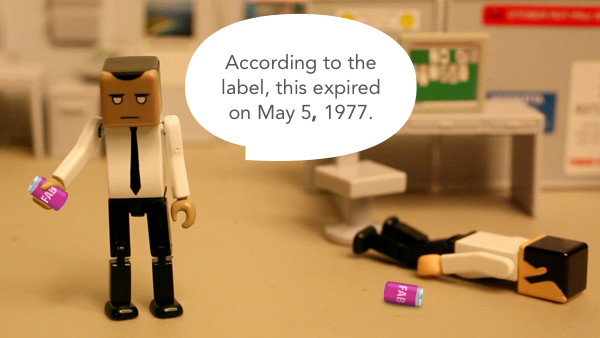
Dates work well-nigh the same way. For case, when you lot write the full engagement, it should look something similar this: January 1, 2014. It's almost equally if the day and the month are inside the year—which is true, in a mode. Nosotros're talking about January 1 in the year 2014. That'due south why there's a comma betwixt the date and yr.
Quotations
Quotations are usually made upwards of two things: a quote (what the person said) and a tag (the person who said it). Commas play an important role too—they separate the quote from the tag, so nosotros can tell they're separate but connected.
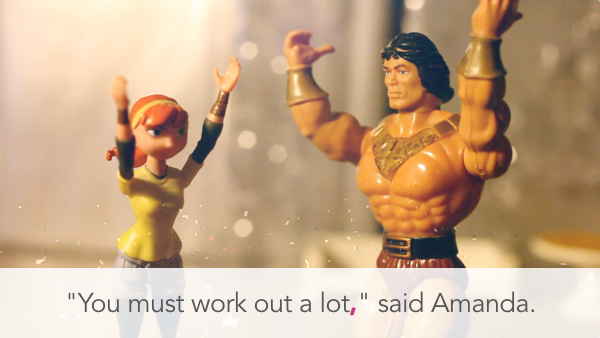
So where does the comma go? It depends on the layout of the sentence. Here are iii examples.
- Before the quote: Vanessa asked, "Is anyone else hungry?"
- Afterwards the quote (inside the quotation mark): "I could go for some pizza," said Elizabeth.
- Both ways (in the middle of a quote): "I want pizza," said Rick, "but non with anchovies!"
To learn more, take a look at our lesson on Quotation Marks.
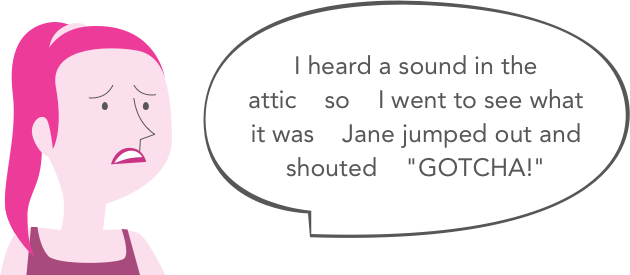
There are two commas missing from the example below. Can you tell where they're supposed go? Click the dots to see if y'all're correct!
Nope!
That's not quite right, but yous're close. Remember: when joining two sentences, the comma always goes before the conjunction.
That's right!
This is where the first comma should go—right before the conjunction . It tells you lot where one thought ends ( I heard a sound in the attic ) and another i begins ( I went to see what information technology was ).
Attempt again!
This should be a flow , not a comma. You can tell because the next sentence is a consummate sentence (and there'southward no conjunction joining them together).
Correct!
This is a skillful example of a quote that comes after a tag. In a case like this, the comma e'er goes before the quote (exterior the quotation marks).
More commas
To use commas in more than complicated sentences, yous'll have to use your judgment. This ways you lot'll need to retrieve about each sentence (and brand certain you really understand what makes it work) earlier y'all can apply the comma.
Don't let this scare you. As always, it's not the end of the globe if y'all brand a mistake. If you go stuck on a rule, endeavor looking closely at the example—sometimes information technology helps to run into the rule in activity. If yous're non a native English speaker, these rules can exist particularly difficult to grasp. Yous may desire to inquire someone you know for help, such equally a friend, coworker, or teacher.
Adjectives
Some other time you lot use commas is when you take two or more adjectives in a sentence. But place the comma between them—this separates them and makes the sentence easier to read.
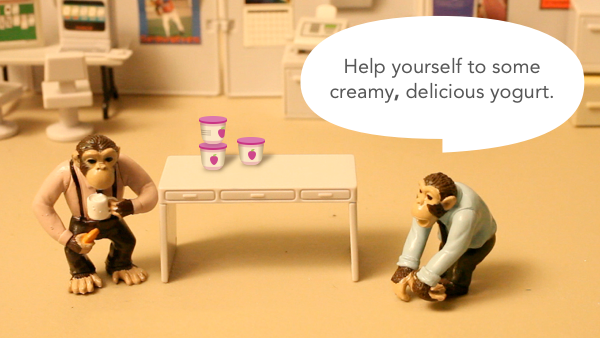
This rule is pretty universal, but it isn't e'er true. You lot should only use a comma if the adjectives are interchangeable.
Interchangeable means yous can list the adjectives in any club and it won't modify the significant of the sentence. To find out if two adjectives are interchangeable, try reversing them—then run across if the judgement still makes sense.

Here's the aforementioned example with a different pair of adjectives: delicious and frozen. This time, the adjectives aren't interchangeable. (If yous contrary them, y'all tin probably see why.) This means they shouldn't be separated with a comma.

The truth is, frozen yogurt is more than than just an adjective followed by a substantive. It's type of thing, like a miniature poodle, striped shirt, or even hot chocolate. All of these examples are made upwardly of two words, but they represent a single thing. If you carve up them with a comma—or write them in a different order—the words lose their meaning.
Introductory clauses
You might already know that an incomplete sentence is a fragment. When you begin a sentence with a fragment, it'southward called an introductory clause. (To acquire more, bank check out our lesson on Fragments.)
It'southward perfectly OK to brainstorm a sentence this way, then follow it with a consummate idea. You just have to separate these thoughts with a comma. This makes the sentence easier to read, and it also tells the reader where to pause if needed.
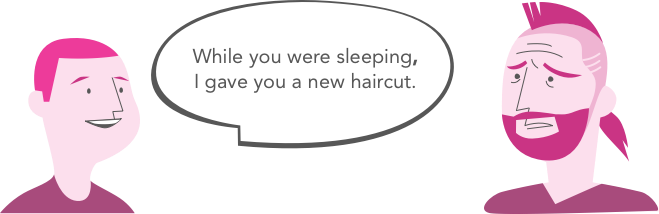
In the instance in a higher place, the thing earlier the comma (while you were sleeping) is a fragment; the affair later on the comma (I gave you a new haircut) is a consummate sentence. The comma is necessary just if the clause introduces the sentence. If the phrases were written in the opposite order, you wouldn't use a comma.
What about expressions like luckily, however, and as you can see? Information technology'southward more mutual to see these at the beginning of a sentence, but they tin announced the end besides. Different introductory clauses, they don't necessarily add together anything new to the sentence. Regardless, they should always be separated by a comma. For example: I gave yous a new haircut, as yous can see.
Nonessential clauses
Yous should also apply commas to carve up nonessential clauses that appear in the middle of a sentence. A nonessential clause is something that adds meaning but that isn't completely necessary. In other words, if yous took information technology out the sentence would nevertheless hateful basically the same thing.
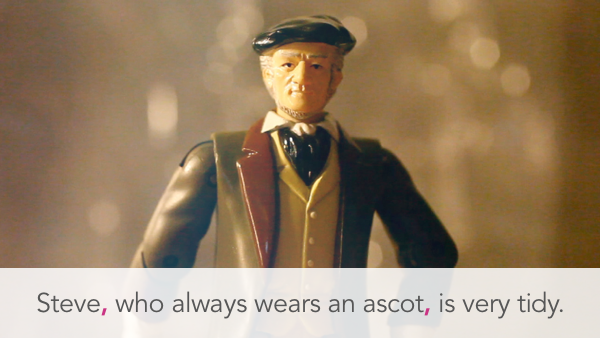
To find out if a clause is nonessential, endeavour removing it from the sentence, then see how information technology sounds. The judgement above would still make sense if we removed the detail well-nigh the ascot. It would exist: Steve is very tidy.
If the clause was essential, we wouldn't be able to remove it. Try this sentence instead: Men who wear ascots are very tidy. If we take out the detail nearly the ascot, nosotros're left something slightly different: Men are very tidy. This is far likewise full general to be truthful—after all, some men are really sloppy. This is how you know the clause is essential to the sentence's meaning.
Other cases
As you proceeds more than experience with commas, you'll run across cases when your judgment matters more than e'er. These cases are more than difficult to define, merely they build on the rules we just discussed.
For instance, some sentences end with a type of fragment called a complimentary modifier. This is only a fancy word for something that clarifies or relates to another role of the sentence. When you apply a free modifier like this, e'er carve up it with a comma.

Other sentences cease with a distinct intermission, followed past something more cryptic. That final beat could be the name of the person yous're talking to, a argument of confirmation, or a single discussion. Whatever information technology is, that beat also should be separated by a comma.
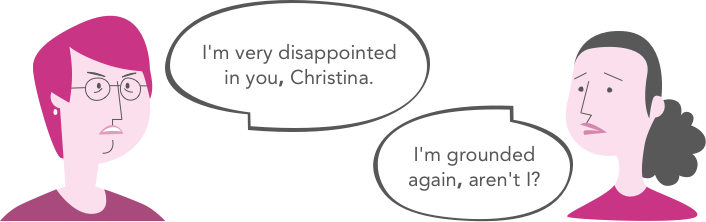
Below are two sentences that include a series of commas—one is correct, and the other is non. Use what you lot merely learned to decide which one is correct, and so click the dots to see if yous're right!
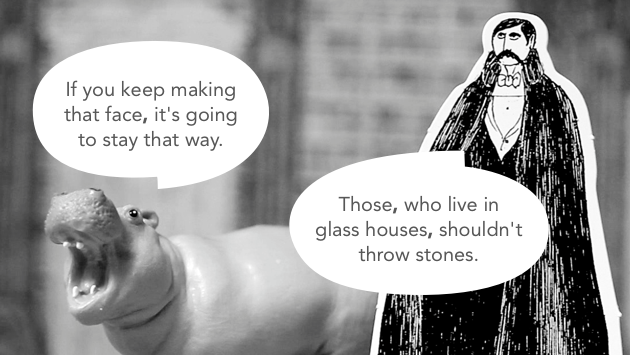
Not quite!
Here, an essential clause has been mistaken for a nonessential clause . The judgement should be written without commas instead:
Those who live in glass houses shouldn't throw stones.
Correct!
The comma in this sentence is used correctly. Information technology separates the introductory clause ( if y'all keep making that face ) from the remainder of the sentence ( it's going to stay that way ).
Common comma mistakes
Joining two sentences without a conjunction
People oft make the mistake of using a comma to join two sentences without a conjunction. For example:
![She was a small-town girl, he was a city boy. [WRONG] / She was a small-town girl, and he was a city boy. [RIGHT]](https://media.gcflearnfree.org/ctassets/modules/49/small-town_girl.png)
Notice how the first version of the sentence is missing something? Information technology needs a conjunction like and or but to join the ii halves properly. You could likewise use a semi-colon to correct it instead: She was a modest-town-daughter; he was a city boy . Or you could rewrite the sentence as two sentences, with a period in betwixt.
Joining a chemical compound subject field or predicate
Remember how y'all're supposed to utilize a comma to dissever 3 or more than items in a listing? Be careful non to go overboard and offset separating two items that vest together (in other words, a compound subject or predicate).
![Aunt Ruth used to date the gym teacher, and the principal. [WRONG] / Aunt Ruth used to date the gym teacher and the principal. [RIGHT]](https://media.gcflearnfree.org/ctassets/modules/49/aunt_ruth.png)
It might help to recollect of the compound equally a single idea or idea. In the case above, the gym instructor and the main are both function of Aunt Ruth's dating history—and they're the only things listed. You wouldn't break them up unless and the principal was rewritten every bit a complete sentence. For case: Aunt Ruth used to engagement the gym teacher, but she dumped him for the principal .
When a fragment follows a sentence
Information technology's easy to misfile a fragment at the end of a sentence with an introductory clause—they do look similar. Nosotros already touched on this dominion when we went over introductory clauses, only it can't injure to review information technology once more.
![I went to Vegas, while my husband went camping. [WRONG] / I went to Vegas while my husband went camping. [RIGHT]](https://media.gcflearnfree.org/ctassets/modules/49/vegas_camping.png)
A fragment only works as an introductory clause if it'south at the kickoff of a sentence. If it'due south at the end, y'all don't need a comma. In this example, the judgement would need a comma only if it was written in the reverse order: While my husband went camping, I went to Vegas .
Forcing a break
Using a comma to strength the reader to pause is a common mistake. Merely remember: Commas are meant to make things easier to read, non necessarily influence the fashion they're read.
![And that, is how you deep-fry a turkey. [WRONG] / And that... is how you deep-fry a turkey. [RIGHT]](https://media.gcflearnfree.org/ctassets/modules/49/deep-fry_turkey.png)
If you want the reader to suspension, you'll have to get creative with your formatting. For instance, you lot could apply an ellipses (a very mutual way of indicating a pause), like in the instance higher up. Or yous could write the give-and-take you want to emphasize in all caps or italics. This fashion, the reader tin really experience the weight of it: And THAT is how you lot deep-fry a turkey .
/en/grammar/homophones/content/
Source: https://edu.gcfglobal.org/en/grammar/commas/1/
0 Response to "Where Should the Comma Go in the Following Sentence? Play It Again Sam."
Post a Comment