2ho Is the God of Wisdom Weaving and the Arts
Athena
Athena was the Greek goddess of wisdom, crafts and weaving, and the arts of war. The patron goddess of Athens, she was ane of the Twelve Olympians and gave her favor and guidance to many famous Greek heroes.
By Thomas Apel and Avi Kapach Terminal updated on Apr. 18th, 2022

-
Later on Zeus swallowed his married woman, Metis, to keep their child from overthrowing him, Athena sprang from her father'south forehead fully grown and wearing armor.
-
Athena was one of the three virgin goddess and never married, had children, or even barbarous in love.
-
Athena valued Odysseus'due south cleverness and cunning, and oftentimes gave both advice and direct assist to him on his voyage dwelling.
Sagacious Athena was i of the twelve chief Olympian deities and the goddess associated with wisdom, craft, and warfare. In war—where she was well-nigh commonly depicted—Athena embodied rationality, tactics, and strategy. Athena'south common cold logic stood in direct contrast to her brother Ares' rage, violence, and impulsiveness.
While Athena was broadly worshipped throughout the Greek world, her cult was peculiarly strong in Athens, the intellectual eye of the Greeks. At that place the goddess was commemorated via the construction of several public buildings, including the famed Parthenon. Her prominence in Athens and elsewhere suggests that the characteristics of wisdom, forethought, and rationality were highly valued amidst the Greek people.
#Etymology
Scholars have debated the origin of the proper name "Athena" since the time of Plato; his dialogue Cratylus contained a rare and lengthy discussion of the history of the name. Speaking through the effigy of Socrates, Plato attributed the proper noun's origin to Homer, who had cobbled it together from the Greek words nous ("mind") and dianoia ("intelligence"). As Plato put it: "The maker of names [Homer] appears to have had a singular notion about her, and indeed calls her by a still higher title, 'divine intelligence' (theou noēsis)."1
Though Plato's word of Homer provides some insight into Athena's esteemed reputation, this caption for her name is most certainly incorrect. According to the best bachelor show, the proper name "Athena" is connected to Athēnai, the Greek name for the city of Athens.
In a kind of "chicken-or-egg" dilemma, scholars have debated whether the city was named for the goddess or the goddess for the city; nowadays, however, it is generally believed that the goddess Athena took her proper name from the city of Athens.2 This is probably why the goddess does not have an individual name in the earliest texts from ancient Greece (Mycenaean inscriptions from the Bronze Age), in which she is called simply a-ta-na po-ti-ni-ja—"Lady" or "Mistress of Athens."
Such a naming scheme was not uncommon among the aboriginal polytheists, who frequently named deities after the places with which they were virtually unremarkably associated. Unfortunately, the origins of the word Athēnai are shrouded in mystery: the root is neither Greek nor Indo-European.3 Thus, the meaning of the name "Athena" remains unclear.
#Pronunciation
-
English language
Greek
Athena
Ἀθήνη
-
Phonetic
IPA
[uh-THEE-nuh]
/əˈθi nə/
#Other Names
Athena'due south name is sometimes transliterated as Athene [uh-THEE-nee] rather than Athena. The ancient Greeks also called the goddess Pallas Athena or but Pallas.
Athena's Roman analogue was Minerva.
#Epithets
Athena was chosen many things. Mayhap her most common epithet (which sometimes functioned equally an alternating name) was Pallas. The origins of this title are aboriginal and obscure and became much intertwined with Athena's mythos (run across below).
Athena's other of import titles included Parthenos ("virgin"), Promachos ("she who fights in the front"), and Erganē ("of the crafts"). In Athens, the urban center with which she was almost intimately connected, Athena was often simply called "the goddess."
In literature, i of Athena'southward almost common epithets was Glaukōpis, commonly translated as "bright-eyed" or "greyness-eyed" (Glaukōpis is derived from the Greek words for "confront" and "owl," Athena's bird). Athena was also oft called Tritogeneia (likely meaning "Triton-born"), a name that may indicate that in some early versions of her myth the sea god Triton was her male parent or foster father.
#Attributes
In art, Athena was ofttimes depicted in full armor. Medusa'south head was almost always part of this armor, displayed on Athena's breastplate or on her shield, the custodianship. Thus clad for state of war, Athena could be seen in the company of the heroes she loved and supported.
Athena was also frequently pictured in the company of olives and owls. Indeed, Athena was most commonly associated with the clever and precipitous-eyed owl (this is probably the ground of Athena's epithet Glaukōpis, explained above).

Greek statuary statuette of Athena with an owl (ca. 460 BCE).
Metropolitan Museum of Art / Public Domain#Family
According to the most popular mythologies surrounding her, Athena was born (or, perhaps more than accurately, emerged) from the union of Zeus and his first married woman, Metis. She was their just kid.iv
Before long later on Metis became pregnant, Zeus heard a prophecy foretelling his downfall at the hands of his own child. Fearful of his impending doom, Zeus swallowed Metis and her child, simply as his own father, Cronus, had swallowed Zeus' brothers and sisters—Demeter, Hades, Hera, Hestia, and Poseidon.
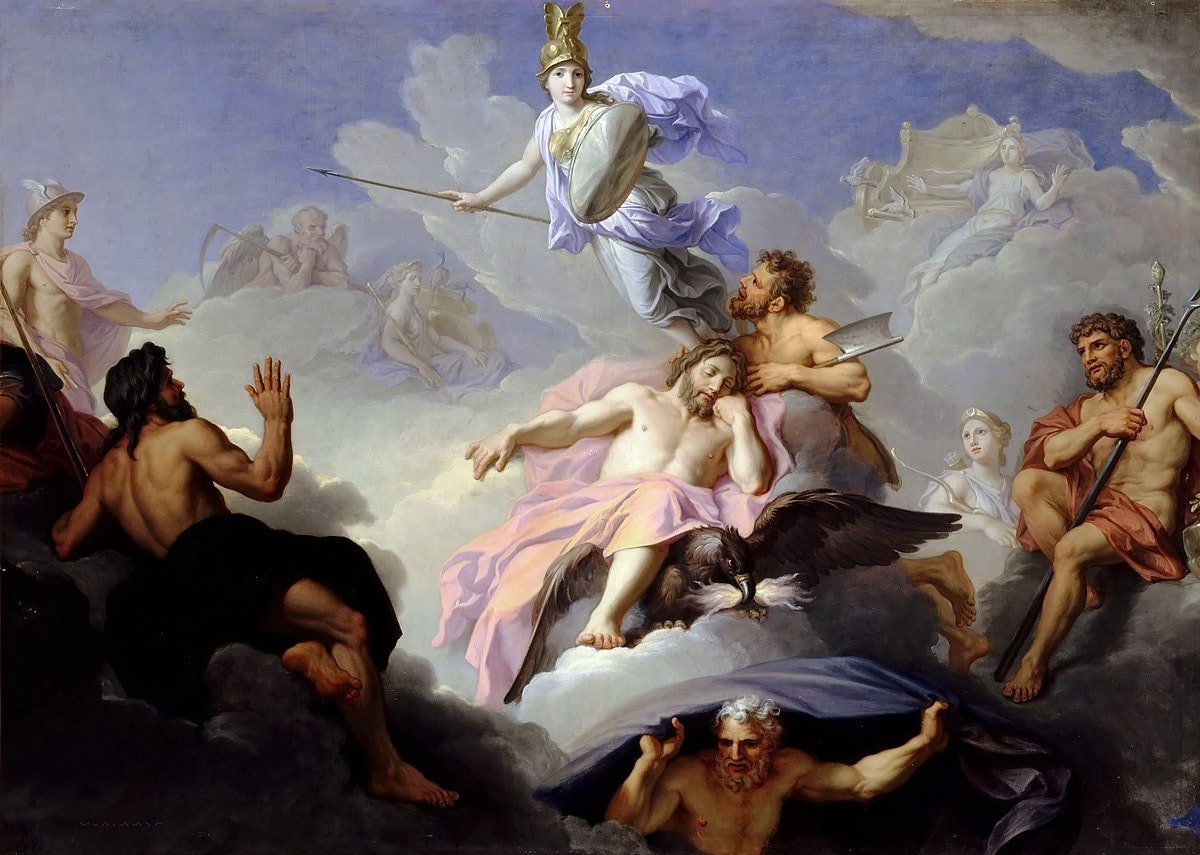
Minerva Born from the Head of Jupiter by René-Antoine Houasse (before 1688). Palace of Versailles.
Wikimedia Commons / Public DomainThe child within Metis, however, would not be denied. One day, Athena suddenly burst forth from Zeus' forehead. She was fully grown, armed with a spear, and dressed in her battle armor. Some accounts featured Hephaestus, Prometheus, or some other mythical figure serving every bit a midwife of sorts by prying open Zeus' head with an axe.5 This moment was commonly depicted in ancient art and has been the subject of more contempo pieces every bit well.
Despite the rough start to her relationship with Zeus, Athena soon became his favorite child. She would often provide her male parent with sage advice and counsel that helped Olympus through many hardships.
Equally a virgin goddess, Athena never married, took a lover, or had children.
#Family Tree
-
Parents
father
mother
- Zeus
- Metis
-
Siblings
brothers
sisters
- Apollo
- Ares
- Hermes
- Dionysus
- Hephaestus
- Heracles
- Minos
- Rhadamanthus
- Perseus
- Aphrodite
- Artemis
- Persephone
- Eileithyia
- Hebe
- Helen of Troy
- Graces
- Moirae
- Muses
#Mythology
Greek mythology, specially the lore surrounding the founding and history of Athens, was rich with stories of Athena. While certain figures from the Mycenaean era paralleled Athena in her essential attributes, traditional conceptions of Athena evolved during the Greek classical menstruation (490–323 BCE). She was later worshipped by the Romans as the deity Minerva. Her longevity among the Greeks and Hellenized peoples suggests that they greatly admired the qualities of wisdom, perspicuity, and forethought with which Athena was associated.
#Athena and Pallas
The story of how Athena acquired the boosted name Pallas was already lost to history in ancient times; the Greeks did, however, devise myths to explain Athena's double name. There were several versions of this aetiological (i.e., explanatory) myth.
In i version, Pallas was a close childhood friend of Athena. One day, while they were playing, Athena killed Pallas past blow. She was heartbroken. To accolade her dead friend, she took the name Pallas for herself. She as well carved a wooden image of Pallas, called the Palladium, which was said to guarantee the invincibility of the urban center that possessed information technology (in various traditions, the Palladium was said to be in Troy or even Rome).6
In some other version, Pallas was one of the Giants whom the Olympians battled in the Gigantomachy. After killing Pallas in combat, Athena flayed him and wore his invulnerable skin equally armor.7
In yet another (even more obscure) version of the story, the Pallas in question was non a Giant but Athena's own father (in this tradition, apparently, Athena was non Zeus' girl). When Pallas attempted to violate Athena, she killed and flayed him.8
#Athena and the Founding of Athens
A common thread in Athena's mythos was how she came to exist the patron of the city of Athens. One myth claimed that she and Poseidon competed for the laurels in the early days of the polis. The two deities each decided to bestow a gift upon the Athenians and agreed to let a guess select the all-time (sources disagree on the identity of the judge/judges: some say information technology was the king of Athens, others that it was the Olympian gods).
In most versions, Poseidon thrust his trident into the footing, unleashing a torrent of salt water as a souvenir. In Roman versions, he brought the first horses to the Athenians.9 Athena, meanwhile, offered the first olive tree. Olives chop-chop became a staple of the Athenian nutrition, and the tree itself became the foundation of the city's economical success in the form of lucrative oil exports. Athena was chosen as the winner, thus inaugurating a lasting relationship between the deity and the city. Poseidon, aroused at having lost, flooded much of the surrounding region of Attica.
Known as Athena Parthenos ("virgin"), she avoided the erotic entanglements and sexual controversies that ensnared the other gods and goddesses. In that location was, however, ane important exception to this rule—one that builds on Athena's reputation as founder and protector of Athens.
There were two wide versions of this myth. In one, Hephaestus attempted to rape Athena, only she pulled herself away from her aggressor, causing him to ejaculate on her thigh. Athena wiped his seed off with a tuft of wool and threw it on the ground. This activity impregnated Gaia, the earth goddess, who gave life to Erichthonius, i of the early, legendary rulers of Athens.10 Erichthonius would likewise become one of the central figures in Athenian festivals jubilant the origins of the city.
In another version of this story, Hephaestus, claiming his privilege as Athena'south axe-wielding midwife, persuaded Zeus to consent to a union betwixt Athena and himself. Though they were married, Athena stole away from the wedlock bed and left Hephaestus to ejaculate on the floor. As in the other version of this myth, his seed so impregnated Gaia and led to the conception of Erichthonius.eleven
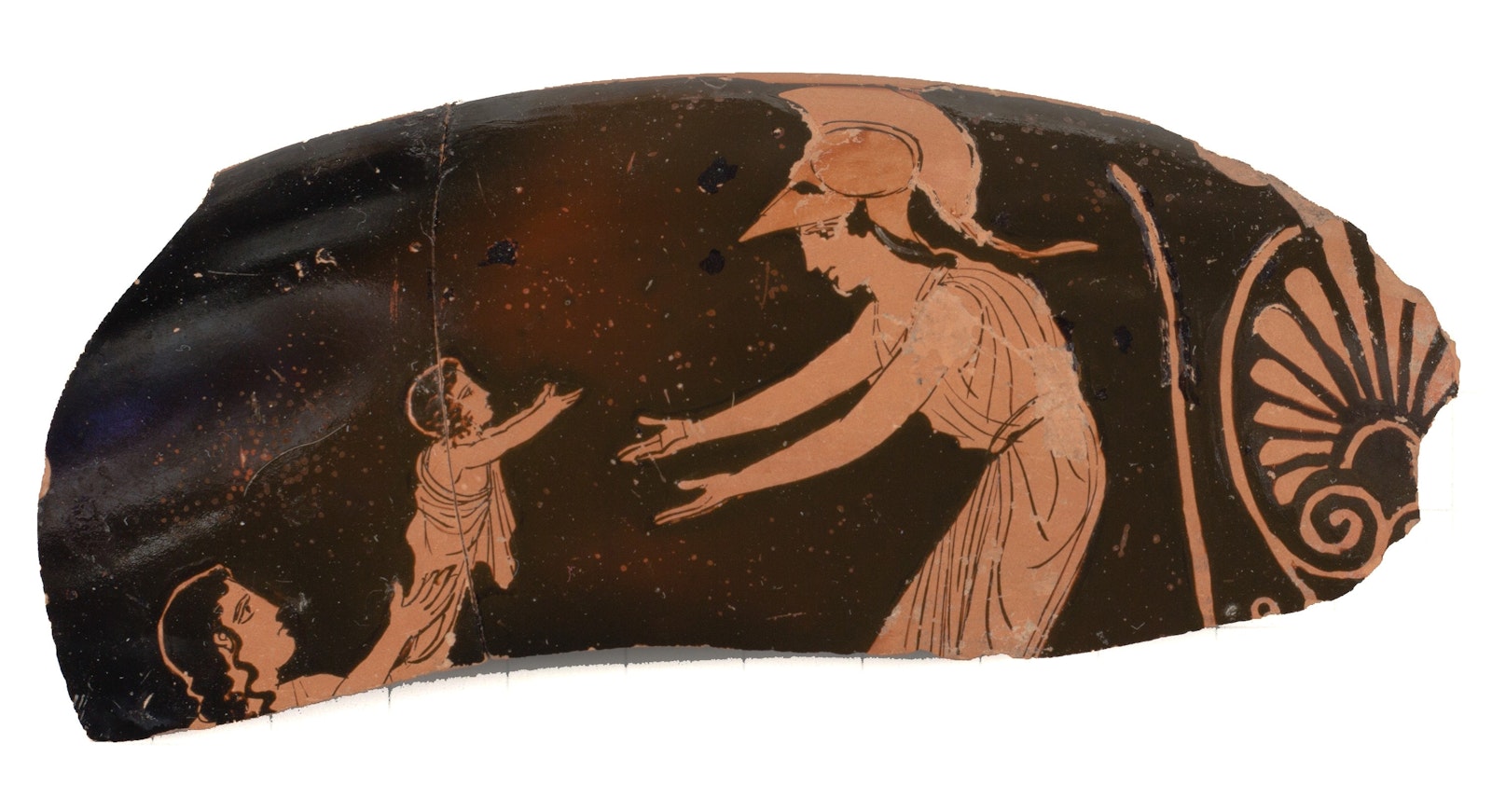
Athena receives the baby Erichthonius from Gaia, on a fragment of a kylix, or a drinking cup (5th century BCE).
Metropolitan Museum of Art / Public DomainFrom here, the story meanders in unexpected directions. Once Erichthonius was born, Athena placed him in a breast and entrusted it to the three daughters of Cecrops—Herse, Pandrosus, and Aglaurus—telling them not to look within. When curiosity got the better of them, the sisters opened the container, but to detect a coiled ophidian.
Other stories claimed that there was a kid guarded by a snake in the breast, or that the child's legs had been transformed into a serpent's tail. The sisters were subsequently either attacked and killed by the snake or, in other versions, were driven mad by the horrific sight and threw themselves from the Acropolis, the hilltop fortress of Athens.12
In artistic representations, Athena was sometimes depicted alongside the ophidian. Fable soon established this serpent as a protector of Athens.
#A Goddess's Wrath: Four Tales of Athena'south Vengeance
Similar the other Olympian gods, Athena could be benevolent but as well extremely barbarous. She was especially harsh in punishing those that offended her, and there are several myths that attest to the potency of her vengeance.
Arachne
One example of Athena'due south acrimony is the myth of Arachne. Though this myth has get quite famous, information technology was not well known in antiquity. About the only source for it is the Roman poet Ovid, who wrote in the late start century BCE and early first century CE. Co-ordinate to Ovid'south Metamorphoses, Arachne was a weaver who lived in Lydia. Her skill earned her great fame, which caused her to become conceited—then complacent, in fact, that Arachne challenged Athena herself to a weaving competition.
During the competition, Arachne chose to weave a tapestry of myths in which the gods debased themselves or were humiliated. Athena, horrified by this insult, destroyed Arachne's work and beat her with her distaff. Arachne then hanged herself out of shame. Pitying the poor girl, Athena transformed Arachne into a spider who constantly wove her silken web.xiii
Tiresias
In another myth, recounted by the tertiary-century BCE poet Callimachus, Athena was bathing in a river on Mount Helicon ane mean solar day. She was attended by one of her shut friends, the nymph Chariclo. Tiresias, Chariclo's son, happened to be hunting nearby and unfortunately stumbled upon Athena as she bathed. Athena was horrified that a mortal had seen her naked and struck Tiresias bullheaded as punishment. Chariclo, however, begged Athena for mercy; softened by her friend's pleas, Athena gave Tiresias the gift of prophecy to make upwardly for his lost eyesight.14
Marsyas
Athena was also indirectly responsible for the terrible fate suffered by the satyr Marsyas. Every bit early as the 5th century BCE, Athena was said to have invented the aulos, a Greek musical instrument resembling the flute.xv Some traditions, however, claim that when Athena saw how silly she looked while playing the aulos—she happened to catch a glimpse of her reflection in a puddle of h2o—she threw abroad the instrument and cursed everyone who picked it up.16
Ignorant of the expletive, an unsuspecting satyr named Marsyas picked up the instrument and became a virtuoso player. He eventually became and then skilled that he challenged Apollo himself, the god of music and the arts, to a music competition. Though he played beautifully, Marsyas' audacity angered Apollo, who had him skinned alive for his trouble.
Medusa
In afterward sources, Athena was also continued to the myth of Medusa. Co-ordinate to Ovid's Metamorphoses, Medusa was originally a beautiful maiden. She was then cute, in fact, that the bounding main god Poseidon fell in love with her and slept with her in a temple of Athena.
The virginal Athena did non appreciate this act of sacrilege, and, rather capriciously, decided to punish Medusa rather than Poseidon: she transformed Medusa's lovely pilus into snakes and made information technology so that anybody who looked upon her was immediately turned to rock.17 After, to add together insult to injury, she helped Perseus in his quest to kill Medusa.
#Athena, the Benefactress of Heroes
Athena appeared ofttimes in Greek mythology as a champion of heroes such equally Argos, Perseus, and Heracles. These stories celebrated Athena's kind regard for struggling mortals and often displayed her craftiness and ingenuity. For instance, Athena advised Argos on how to construct the Argo, the ship that took Jason and the Argonauts to find the Golden Fleece.
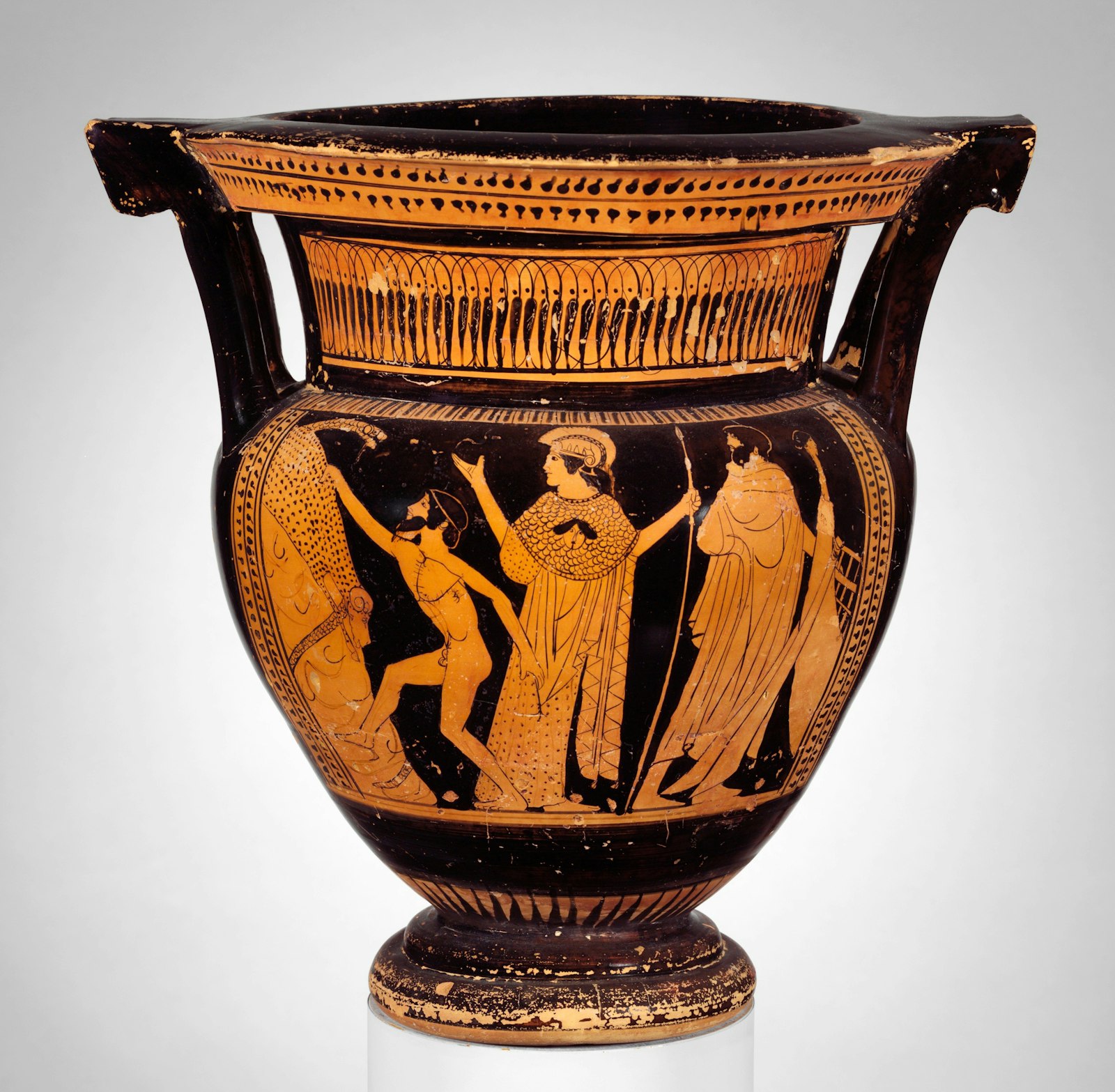
A painted terracotta bowl depicts Athena, center, as she accompanies Jason reaching for the Golden Fleece. A third figure at right prepares to board the ship Argo (ca. 570–60 BCE).
Metropolitan Museum of Art / Public DomainAthena played a larger office in the myth of Perseus, whom she aided in his quest to slay Medusa, the Gorgon with hair fabricated of serpents whose gaze turned onlookers to rock. As he set out on his quest, Athena appeared earlier him and gave him a bronze shield, polished to reverberate the sight of Medusa so that Perseus would not have to look in her eyes.
Athena was also involved in the myth of Bellerophon, the son of Poseidon who killed the Chimera. According to the poet Pindar, Athena was the 1 who taught Bellerophon how to tame and ride the immortal winged horse Pegasus.18
Even the great Heracles benefitted from Athena's intervention; she came to his assistance when he was ordered to steal the golden apples from Hera'south cloak-and-dagger garden, which was overseen by the daughters of Atlas. Atlas, a Titan, had been sentenced to hold up the sky for all eternity subsequently losing to Zeus in the great war between the gods and the Titans. Heracles, in gild to complete his chore, offered to hold the heaven while Atlas beseeched his daughters to gather the apples.
When the sky proved likewise heavy for the mighty Heracles, Athena took action and lifted it then that he would not exist crushed under its weight. This scene was sometimes represented in artistic representations of this labor.
#Athena in the Iliad and Odyssey
Athena played central roles in Homer's epic poems. Long before the events of the Iliad, Hera, Aphrodite, and Athena each claimed to be the fairest of all the goddesses. They commissioned Paris, prince of Troy, to judge which of them was truly the well-nigh beautiful.
Each of the goddesses tried to ransom him—Hera promised political power, Athena offered the glories of military triumph, and Aphrodite agreed to permit Paris to marry the most beautiful woman alive. Paris chose the latter souvenir, which happened to exist Helen, married woman of Menelaus, the king of Sparta. It was Helen'south abduction that sparked the Trojan War.
In the Iliad, it is implied that Athena and Hera's hatred of the Trojans resulted from the insult they had received in the Judgment of Paris. These two goddesses thus emerged as the well-nigh committed and consistent allies of the Greeks in the Iliad as they assailed and ultimately conquered Troy.
Often Athena's help took the course of wisdom whispered softly to foolhardy mortals. She paid special attention to Achilles, whose rage toward Agamemnon threatened to disengage the tenuous Greek alliance. As Achilles prepared to draw his sword and impale Agamemnon, Athena appeared, proverb:
I have come from heaven to stay your acrimony, if yous will obey, The goddess white-armed Hera sent me along, for in her heart she loves and cares for both of y'all. Simply come up, cease from strife, and do non grasp the sword with your hand. With words indeed taunt him, telling him how it shall be. For thus will I speak, and this thing shall truly be brought to pass. Hereafter iii times as many glorious gifts shall be yours on business relationship of this arrogance. But refrain, and obey usa.nineteen
Later in the state of war, the two sides decided that the disharmonize might exist best adamant through unmarried combat between Menelaus and Paris. Athena was anxious to resume the fighting, however, and disguised herself as a Trojan soldier named Laodocus.
In this guise, she persuaded a full general and Trojan ally chosen Pandaros to fire an arrow at Menelaus, promising that the death of the Spartan rex would end the conflict. When Pandaros fired, Athena contradistinct the path of the projectile, ensuring that it would only injure Menelaus. This treacherous violation of the truce proved ample reason to cancel it altogether. Thus, the war continued.
Athena would again exert decisive influence over the conflict when she championed the warrior Diomedes, granting him strength and courage to lead the battle against the Trojans. When they confronted Ares, who was full of rage and lust for blood, she guided Diomedes equally he thrust his spear into the god, leaving him injured and disabled on the battlefield.
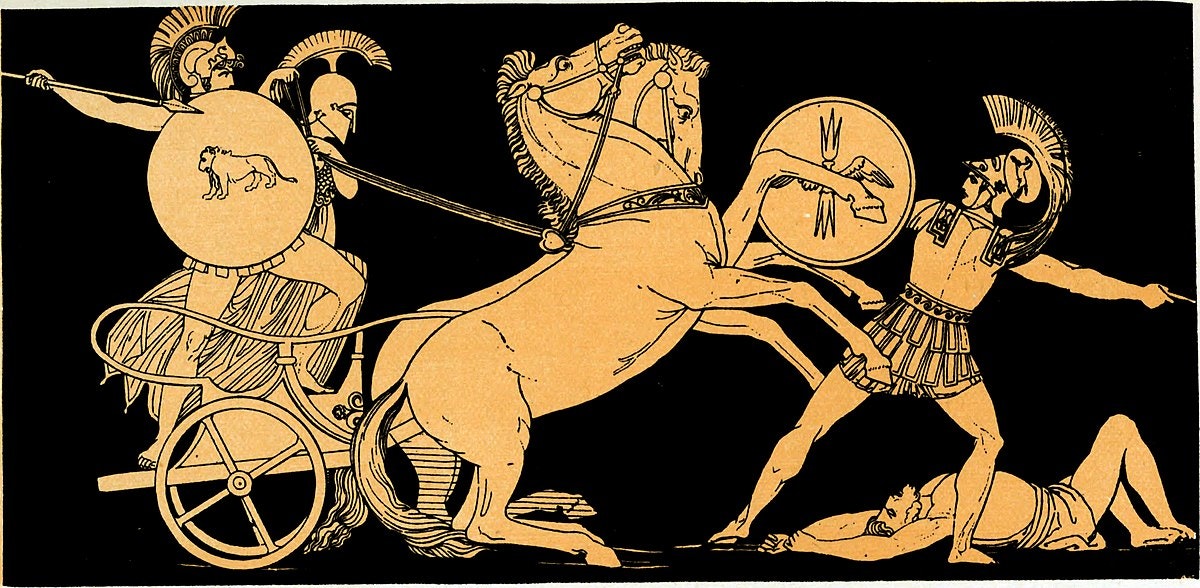
Diomed [i.e., Diomedes] Casting his Spear Against Ares by John Flaxman (1895).
Wikimedia Commons / Public DomainIn the Odyssey, Athena offered wisdom and succor to the embattled Odysseus and his son Telemachus. As Odysseus began his long journey home following the conclusion of the Trojan War, Athena inspired wise thoughts inside his mind. In Ithaca, Odysseus' home, she gave counsel to Telemachus, urging the young homo to seek out information near his begetter.
Only later did Athena appear to Odysseus in person: when he finally returned to Ithaca, she came to him disguised as a shepherd. To stoke his rage, Athena told him that Penelope had moved on—assuming that Odysseus had died, she had taken some other husband.
Trusting in his married woman's allegiance, Odysseus refused to believe the trickster. When Athena saw that she could non fool the shrewd Odysseus, she revealed her true identity to him. Athena then told him the truth: Penelope was besieged by suitors hoping to merits what was rightfully Odysseus', just she remained truthful while pending his return. Athena then disguised Odysseus as a beggar. And then costumed, Odysseus slayed the suitors and reclaimed his wife and home.
#Worship
Athena was worshipped throughout the Greek globe, but her nearly important cult centers were in the cities of Athens and Sparta.
#Temples
Athena was honored with the Parthenon, a huge temple on the Athenian Acropolis (the hilltop fortress and religious middle of the city). Built in the fifth century BCE, during the "Golden Age" of Athens, information technology is arguably the most famous example of ancient Greek architecture. The Parthenon was decorated with beautiful sculptures and friezes, including an enormous cult statue of Athena—called the statue of Athena Parthenos—that stood nearly forty feet tall. Fashioned out of ivory and gold by the renowned sculptor Pheidias, the statue was unfortunately lost or destroyed long agone.
There were other smaller temples of Athena in Athens, including the elegant Temple of Athena Nike (that is, Athena as goddess of victory).
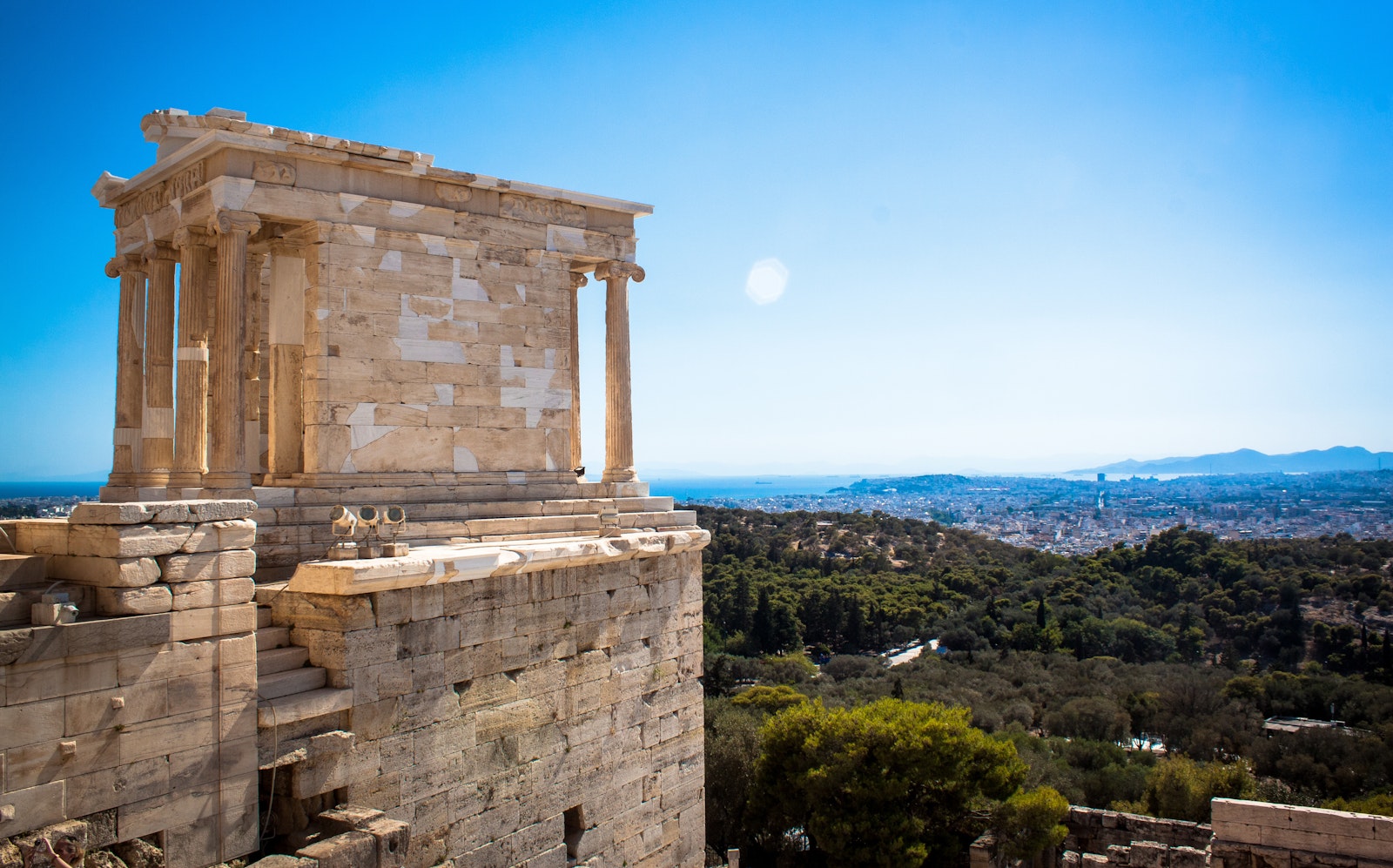
Temple of Athena Nike on the Acropolis in Athens (ca. 420 BCE).
Andy Hay / CC BY ii.0Athena as well had a great temple of the Acropolis of Sparta. This temple, known as the Bronze House, was said to have been built past the mythical rex Tyndareus and his sons Castor and Polydeuces.20 The Bronze House became infamous when, in the fifth century BCE, the Spartans killed the traitorous general Pausanias by trapping him inside. This act of sacrilege was said to have incurred the wrath of Athena. The episode and its aftermath were described by the historian Thucydides, among others.21
#Festivals
The grandest and nearly important festival of Athena was the Panathenaea. This festival was historic in Athens every year, with an even more elaborate version, called the Great Panathenaea, held every four years. The Panathenaea consisted of a procession of young men and women, sacrifices, and athletic games. The festival culminated in the grooming of Athena'south cult statue: the statue was undressed, washed in seawater, and so clothed in a beautiful new robe (chosen a peplos) woven by the women of Athens.
Like festivals were held in other Greek cities as well. In Boeotia, in that location was a Panathenaea-similar festival called the Pamboeotia, but relatively trivial is known about it.
In Athens, Athena's namesake and religious birthplace, the goddess was also honored during the Synoikia. This festival commemorated the aboriginal unification of the region of Attica and included sacrifices to Athena.
#Pop Culture
Athena has made numerous appearances in popular culture. In the boob tube series Xena: Warrior Princess, for example, Athena is an important character, portrayed past Paris Jefferson. Athena is besides prominent in the God of War video game series, where she advises and aids the main protagonist, Kratos, in his quests.
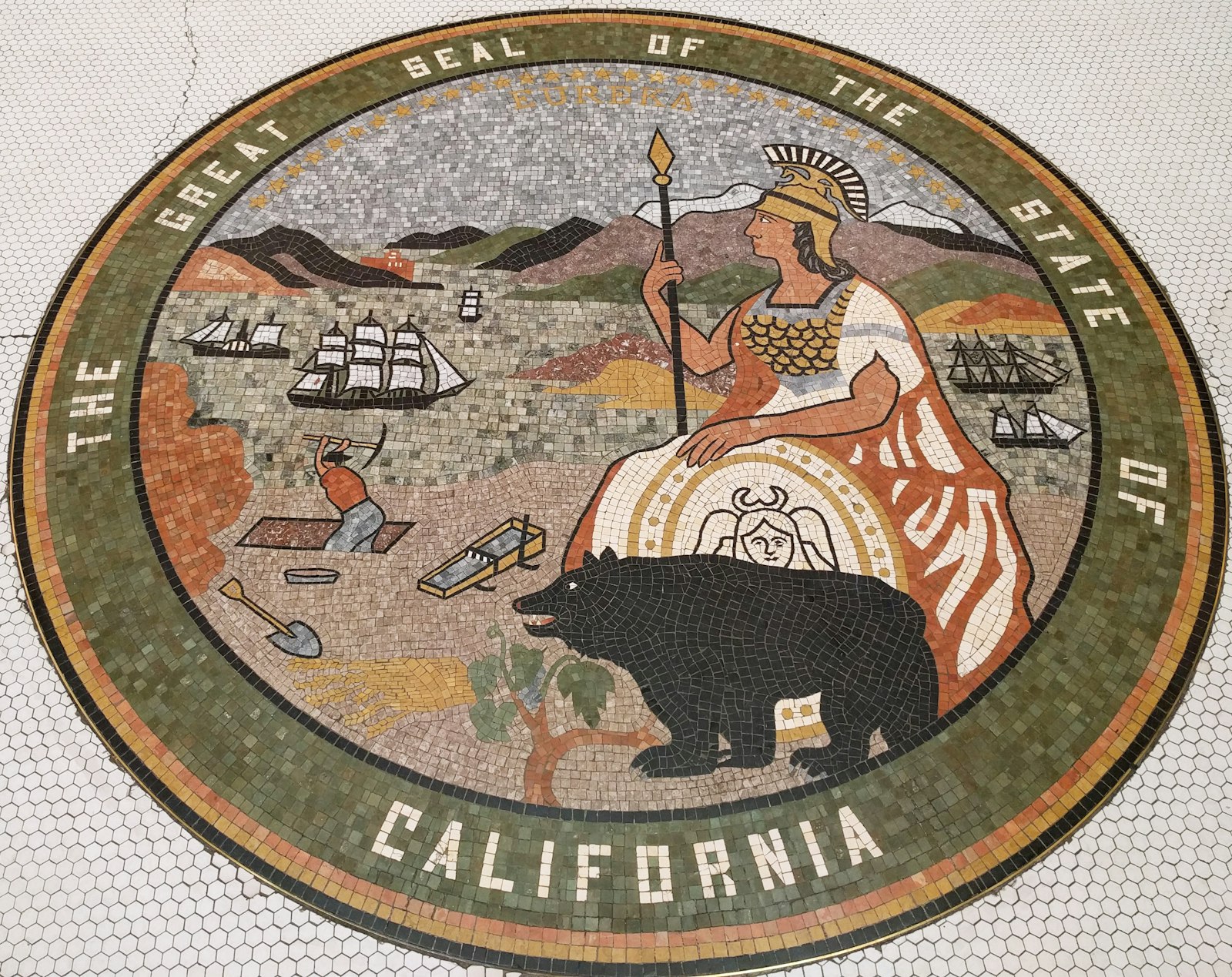
Athena adorns the California land seal, seen hither equally a mosaic on the floor of the San Mateo County History Museum in Redwood Urban center.
Mark Doliner / CC Past-SA 2.0Athena is also featured on the state seal of California. In this depiction, she is shown wearing armor and carrying her spear and shield while looking over a trunk of water, presumed to be San Francisco Bay.
Further Reading
#Master Sources
Greek
-
Homer: Athena plays a central role in the Iliad and the Odyssey (eighth century BCE) as an marry of the Greeks and a shut patron of heroes such as Achilles, Odysseus, and Diomedes.
-
Hesiod: Many myths of Athena, such every bit that of her nascence from Zeus' head, are described in the seventh-century BCE epics of Hesiod, including the Theogony and the Works and Days.
-
Homeric Hymns: In that location are two brief Homeric Hymns dedicated to Athena (eleven and 28), equanimous around the 7th and sixth centuries BCE.
-
Pindar: Athena features in many of Pindar'south Odes (early to mid-5th century BCE) as a benefactress of heroes such as Bellerophon (Olympian Ode 13), Perseus (Pythian Ode 10), and Diomedes (Nemean Ode 10). Athena's invention of the aulos is described in Pythian Ode 12.
-
Aeschylus: Athena plays an important role in the Oresteia trilogy (458 BCE), interceding on Orestes' behalf afterwards he murders his mother, Clytemnestra.
-
Sophocles: Athena is a graphic symbol in Sophocles' Ajax (mid-fifth century BCE), in which she drives the Greek hero Ajax mad to protect Odysseus from his rage.
-
Euripides: Athena is a character in two of Euripides' surviving tragedies, Trojan Women (ca. 415 BCE) and Ion (ca. 413 BCE).
-
Plato: Athena and her importance for Athens are mentioned in some of the dialogues of the fourth-century BCE philosopher Plato, including the Menexenus and Timaeus.
-
Apollonius of Rhodes: Athena plays a minor role in the third-century BCE epic Argonautica every bit a helper and patron of Jason and the Argonauts.
-
Callimachus: In Callimachus' fifth Hymn, Athena punishes Tiresias after he accidentally sees her bathing (encounter higher up).
-
Orphic Hymns: The Orphics were a Greek cult that believed a blissful afterlife could exist attained by living an ascetic life. The thirty-first Orphic Hymn (ca. 3rd century BCE to second century CE) is defended to Athena.
-
Strabo, Geography: A late commencement-century BCE geographical treatise and an of import source for many local Greek myths, institutions, and religious practices from antiquity.
-
Lucian: Athena features in Lucian's satirical Dialogues of the Gods (late first to early 2nd century CE).
-
Pausanias, Description of Hellenic republic: A 2nd-century CE travelogue; like Strabo's Geography, an important source for local myths and community.
-
Quintus of Smyrna: In the fourth-century CE epic Posthomerica, Athena sometimes interferes in the Trojan War on the side of the Greeks, as she does in the Homeric poems.
-
Nonnus: In the epic verse form Dionysiaca (fifth century CE), Athena helps Dionysus in his conquest of India (especially in Books 26, 27, and thirty).
-
Colluthus: Athena'due south participation in the Judgment of Paris is described in the Rape of Helen, a poem from the tardily fifth or early sixth century CE.
Roman
-
Virgil: Minerva (the Roman Athena) serves a minor role equally an enemy of Troy in the Aeneid (19 BCE), an epic poem that tells of how the Trojan hero Aeneas came to Italia every bit the ancestor of the Romans.
-
Ovid: Various myths about Minerva/Athena are told in Ovid'due south Metamorphoses and Fasti (both ca. 8 CE).
-
Valerius Flaccus: In the ballsy Argonautica (first century CE), as in Apollonius' earlier Greek work of the aforementioned proper noun, Minerva/Athena is a helper of the Argonauts.
-
Statius: Minerva/Athena is a patron of the Calydonian hero Tydeus in the tardily get-go-century CE epic Thebaid, just she abandons him at the terminate of his life when he eats the brain of the man who had fatally wounded him.
-
Silius Italicus: In the Punica, a starting time-century CE epic near Hannibal'southward war against the Romans, Minerva/Athena is an ally of Hannibal and saves his life in Book 9.
-
Claudian: Minerva/Athena and the Olympians' ferocious boxing with the Giants is narrated in the fourth-century CE poem Gigantomachy.
Mythological Handbooks (Greek and Roman)
-
Diodorus of Sicily, Library of History: A work of universal history, covering events from the creation of the cosmos to Diodorus' own time (mid-first century BCE). Contains many references to Athena.
-
Apollodorus, Library: A mythological handbook from the first century BCE or the commencement few centuries CE. Myths involving Athena are scattered throughout.
-
Hyginus, Fabulae: A Latin mythological handbook (first or 2nd century CE) that includes sections on the myths of Minerva/Athena.
-
Fulgentius, Mythologies: A Latin mythological handbook (fifth or 6th century CE) with sections on the myths of Minerva/Athena.
#Secondary Sources
-
Burkert, Walter. Greek Faith. Cambridge, MA: Harvard University Printing, 1986.
-
Cartwright, Marker. "Athena." World History Encyclopedia. Published online 2012. https://www.worldhistory.org/athena/.
-
Dirt, Jenny Strauss. The Wrath of Athena: Gods and Men in the Odyssey. Princeton, NJ: Princeton Academy Press, 1993.
-
Deacy, Susan. Athena. London: Routledge, 2008.
-
Deacy, Susan, and Alexandra Villing, eds. Athena in the Classical World. Leiden: Brill, 2001.
-
Gantz, Timothy. Early Greek Myth: A Guide to Literary and Artistic Sources. ii vols. Baltimore, MD: Johns Hopkins University Press, 1996.
-
Graf, Fritz, and Anne Ley. "Athena." In Brill's New Pauly, edited by Hubert Cancik, Helmuth Schneider, Christine F. Salazar, Manfred Landfester, and Francis Grand. Gentry. Published online 2006. http://dx.doi.org/10.1163/1574-9347_bnp_e205490.
-
Graves, Robert. The Greek Myths. London: Penguin, 1955.
-
Guthrie, Due west. K. G. The Greeks and Their Gods. London: Methuen, 1962.
-
Hooker, One thousand. T. W., ed. Parthenos and Parthenon. Oxford: Clarendon, 1963.
-
Kennedy, Rebecca Futo. Athena's Justice: Athena, Athens and the Concept of Justice in Greek Tragedy. New York: Lang, 2009.
-
Kerényi, Károly. Athene: Virgin and Mother: A Study of Pallas Athena. Translated by M. Stein. Woodstock, CT: Spring, 1978.
-
Kerényi, Károly. The Gods of the Greeks. London: Thames and Hudson, 1951.
-
Long, C. R. The Twelve Gods of Hellenic republic and Rome. Leiden: Brill, 1987.
-
Loraux, Nicole. The Children of Athena: Athenian Ideas virtually Citizenship and the Partitioning betwixt the Sexes. Translated by Caroline Levine. Princeton, NJ: Princeton University Printing, 1993.
-
Neils, Jenifer. Goddess and Polis: The Panathenaic Festival in Ancient Athens. Hanover, NH: Hood Museum of Fine art, 1992.
-
Rose, H. J. A Handbook of Greek Mythology. London: Methuen, 1929.
-
Smith, William. "Athena." In A Lexicon of Greek and Roman Biography and Mythology. London: Spottiswoode and Company, 1873. Perseus Digital Library. Accessed Apr 23, 2021. http://www.perseus.tufts.edu/hopper/text?doc=Perseus%3Atext%3A1999.04.0104%3Aalphabetic+letter%3DA%3Aentry+group%3D51%3Aentry%3Dathena-bio-one.
-
Theoi Project. "Athena." Published online 2000–2017. https://world wide web.theoi.com/Olympios/Athena.html.
0 Response to "2ho Is the God of Wisdom Weaving and the Arts"
Post a Comment